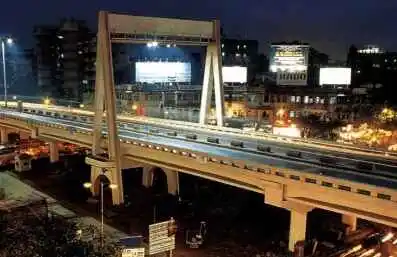
01 / Khodadad Circle Flyover, Mumbai

02 / Khodadad Circle Flyover, Mumbai

03 / Khodadad Circle Flyover, Mumbai
Execution Challenge
The right-of-way was exceptionally narrow and processed tens of thousands of commuter vehicles hourly, leaving zero spatial allowance for aggregate storage or onsite structural staging.
Deep substructural pile boring had to occur directly adjacent to century-old, fragile historic properties, strictly prohibiting traditional percussion impact piling.
Furthermore, the corridor was saturated with unmapped legacy municipal water mains and stormwater trunks that required real-time diversion without utility service disruptions.
Strategic Role
Mr. Avarrsekar directed the high-fidelity pre-bid positioning strategy, mapping the firm’s modular precast capabilities to meet MCGM’s strict technical and safety scoring parameters.
Upon acquiring the project, he established a centralized project governance framework providing rigid risk oversight across the supply chain.
Serving as the primary executive interface with MCGM committees and traffic regulators, he decoupled construction workflows from external pressures, fast-tracking nighttime road permissions to maintain critical path velocity.
Actions Taken
Formulated a micro-phased parallel timeline separating foundation civil tracks from structural launching modules.
Deployed low-vibration hydraulic rotary piling rigs to preserve flanking historical building foundations.
Transferred structural girder fabrication to an offsite pre-casting facility to eliminate onsite space constraints.
Launching multi-ton precast girders using high-capacity mobile cranes within highly restricted nocturnal traffic windows.
Implemented real-time geodetic instrumentation monitoring structural equilibrium along adjacent property lines.
Outcome
The successful commissioning of the flyover achieved immediate, absolute grade separation over three major intersections, dramatically accelerating north-south traffic throughput.
Utilizing prestressed concrete girder spans maximized load-bearing metrics while lowering the city's long-term infrastructure lifecycle maintenance costs.
For the sector leadership, this project validates how translating complex structural risks into precise, data-driven bid solutions secures landmark municipal contracts and ensures highly predictable project execution.
Technical Data of Record
Scope of Work
Turnkey design and construction of an elevated highway flyover covering three major arterial road junctions, including solid earth-retained approaches at either end and prestressed concrete (PSC) girder spans.
Key Specifications
Prestressed Concrete (PSC) girders; monolithic RCC substructural piers; reinforced earth retaining walls for approaches; high-durability bituminous overlay surfacing.
Major Deliverables
Fully operational elevated flyover corridor, multi-junction traffic distribution network, integrated structural bridge deck drainage systems, and modernized surface intersections beneath spans.
Technical Complexities
Executing deep substructural pile boring immediately flanking fragile, century-old historical structures; lifting and launching heavy multi-ton precast PSC girders during micro-restricted night traffic windows; managing dense, unmapped legacy municipal utility channels beneath the right-of-way.
Safety/Quality Measures
Real-time geodetic facade deformation monitoring via high-precision electronic tiltmeters; heavy-duty physical traffic containment barriers and safety catch platforms; 100% third-party material certification and non-destructive post-tensioning stress verification logs.
Location | Client
Khodadad Circle (Dadar TT), Dr. Babasaheb Ambedkar Road, Dadar, Mumbai, India | Municipal Corporation of Greater Mumbai (MCGM)
Discover the Full Strategy
Explore the detailed methodologies, execution frameworks, and deep-dive analytics in our comprehensive case study.
Request the Project Case Study
Popular Project