
Selecting the right project delivery model is the first strategic decision that determines infrastructure tender success.
Every tender loss story eventually gets blamed on “aggressive competitor pricing.” In my three decades bagging and executing monumental infrastructure projects across urban development, transport engineering, and water and dam infrastructure, I’ve learned that most of these losses were decided long before pricing ever came into play. They were decided the moment a company chose to compete in the wrong delivery model.
This is the essence of what I mean when I say tenders are won before they’re bid. Delivery model selection isn’t a technicality buried in the RFP. It’s the first strategic decision that determines whether your genuine strengths will even be visible to the evaluator.
Three Models, Three Different Businesses
Most companies treat BOT, Annuity, and EPC as interchangeable contract formats; variations on “build the project.” They aren’t; each model asks a fundamentally different question of the bidder and rewards a completely different capability set.
EPC asks: Can you build this, on time, within budget? The procuring authority retains ownership and bears operational risk. Evaluation weighs technical capability, execution discipline, and cost competitiveness, the classic contractor’s strengths.
Annuity models ask something else entirely: Can you build this and manage a predictable, government-backed revenue stream for 15-20 years? Traffic or demand risk disappears, replaced by fixed semi-annual payments. But debt servicing discipline and life-cycle O&M cost credibility become central to how bids are scored.
BOT asks the hardest question: Can you build, finance, and correctly forecast a revenue stream nobody can guarantee? This model rewards financial modeling sophistication and balance sheet strength far more than construction excellence.
I’ve seen this play out across sectors I know intimately. A water infrastructure company with an outstanding record executing large-scale distribution and pumping station projects under EPC terms once pursued a BOT water concession and lost, not because their engineering was weaker, but because their financial model couldn’t withstand evaluator scrutiny on tariff-collection risk. Similarly, in dam and irrigation infrastructure, I’ve watched companies win annuity-based canal modernization tenders specifically because they demonstrated sophisticated life-cycle maintenance costing, something purely execution-focused competitors hadn’t prepared for.
Why Companies Choose the Wrong Battlefield
This is the pre-tender failure that sits upstream of every “we lost on price” narrative. A company with genuine urban infrastructure execution strength decides to chase a BOT-Toll highway or a BOT water treatment concession because the headline project value is attractive. They submit a technically sound bid. They lose to a competitor who wasn’t more aggressive on price, however, simply better matched to what the model was actually testing for.
The mistake isn’t capability. It’s failing to recognize, months before the RFP is even published, that the delivery model itself defines the competitive arena and that arena may not be one where your strengths carry weight.
This is precisely where my advisory work begins: not at the bid-writing stage, but well before, when a company is deciding which opportunities are even worth pursuing.
A Framework for Choosing the Right Model
Before pursuing any tender, infrastructure companies should honestly assess three dimensions ideally as part of pre-tender strategic planning, not last-minute bid qualification:
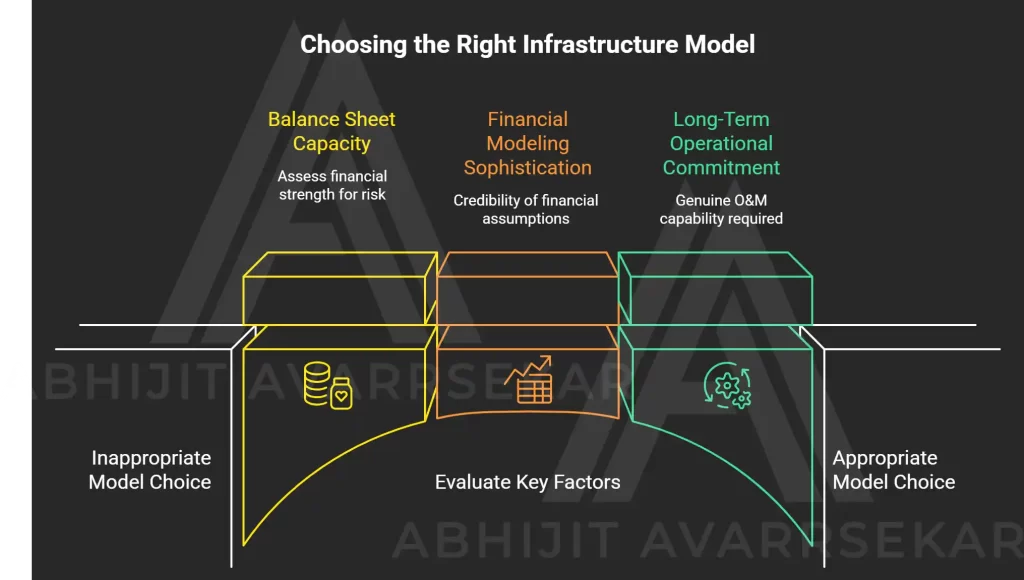
1. Balance sheet capacity for risk absorption.
BOT models demand the financial strength to absorb years of demand uncertainty, whether that’s toll traffic on a highway or tariff collection on a water concession. If your balance sheet can’t comfortably weather a shortfall scenario, you’re not competing on level ground, regardless of engineering pedigree.
2. Financial modeling sophistication.
Annuity and BOT bids are increasingly won on the credibility of financial assumptions, escalation clauses, debt structuring, and sensitivity analysis, not just the underlying numbers. A modernization-stage dam project or an urban water distribution concession will scrutinize this as closely as any highway BOT. If financial modeling isn’t a genuine core strength, EPC remains the more honest and winnable arena.
3. Appetite for long-term operational commitment.
Annuity and BOT concessions run 15-30 years. That’s not a construction project; it’s a multi-decade relationship with a government body, whether the asset is a metro line, an irrigation network, or a water treatment plant. Companies without genuine O&M capability or organisational patience for decades-long asset management consistently underperform in these models.
The Real Lesson
I don’t advise companies to avoid BOT or Annuity opportunities. I advise them to be honest well ahead of any tender about whether their current capabilities actually match what each model tests for, and to build the missing capability deliberately rather than discovering the gap mid-bid.
The infrastructure companies I’ve worked with who win consistently don’t chase every high-value opportunity that crosses their desk. They map their genuine strengths like urban delivery, transport execution, water and dam expertise against what each delivery model demands, months before the tender is published. Sometimes that means walking away from an attractive BOT opportunity to focus where they’ll dominate under EPC terms. Sometimes it means investing a year building financial modeling capability before attempting a first Annuity bid.
This is what differentiation actually looks like in infrastructure tendering. Not a better cover page or not a lower price, but a deliberate, pre-tender decision about which battlefield to enter, made with enough lead time to actually win it.
As they say, “Choose the battlefield before you choose the battle.”
Evaluating whether your next tender should be structured as EPC, Annuity, or BOT? Let’s discuss which delivery model actually plays to your company’s strengths before you commit resources to the bid.
#PPP #BOT #InfrastructureFinance #ProjectDelivery #TenderStrategy #FinancialModeling #InfrastructureIndia #EPC #ProjectAcquisition #StrategicAdvisory

Abhijit Avarrsekar
Strategic Growth Advisor
Synthesizing thirty years of infrastructure excellence into a future-proof Tender Winning Advisory.
Align delivery models with organisational strengths to maximise tender competitiveness, profitability, and long-term project success.
Choose the Right Delivery Model