
Why understanding competitors before the bid is drafted creates stronger positioning and higher tender win rates.
Every infrastructure tender is a two-part exam. The first part is technical and financial; the question is: can you deliver to both? The second part is comparative: are you the best-positioned bidder relative to everyone else in the room? Most companies prepare exhaustively for the first exam that is ‘Technical’ and walk into the second one blind, which is ‘Financial’.
Competitive intelligence closes this gap. It is not espionage, not guesswork, but a disciplined, research-driven understanding of who you’re bidding against, what they’ll emphasise, and where your positioning needs to be sharper than theirs.
Why Competitive Intelligence Is Structural, Not Optional
Consider Mumbai’s recently finalised Manori seawater desalination project. The BMC’s tender went through four unsuccessful rounds before a consortium, Israel’s IDE Technologies paired with Hyderabad-based GVPR Engineers, was finalised at over ₹11,000 crore.
Multiple rounds of a tender failing to close isn’t unusual for complex, high-value infrastructure. It typically signals that early bidders misjudged how the evaluating authority was weighing technology credibility, lifecycle cost transparency, and long-term operational accountability against pure construction pricing.
The consortium that eventually won paired a specialist global technology partner with a contractor that already had an established operational relationship with BMC through the Ghatkopar STP project. That pairing wasn’t accidental; it was a direct response to an implicit evaluation criterion: familiarity and trust with the specific municipal body, not just general capability.
This is what competitive intelligence produces: an accurate read of what evaluators actually reward, translated into a bid structure that reflects it before the RFP is even finalised.
The Five Vectors of Competitor Analysis
A rigorous competitive intelligence framework examines rivals across five dimensions, not just price:
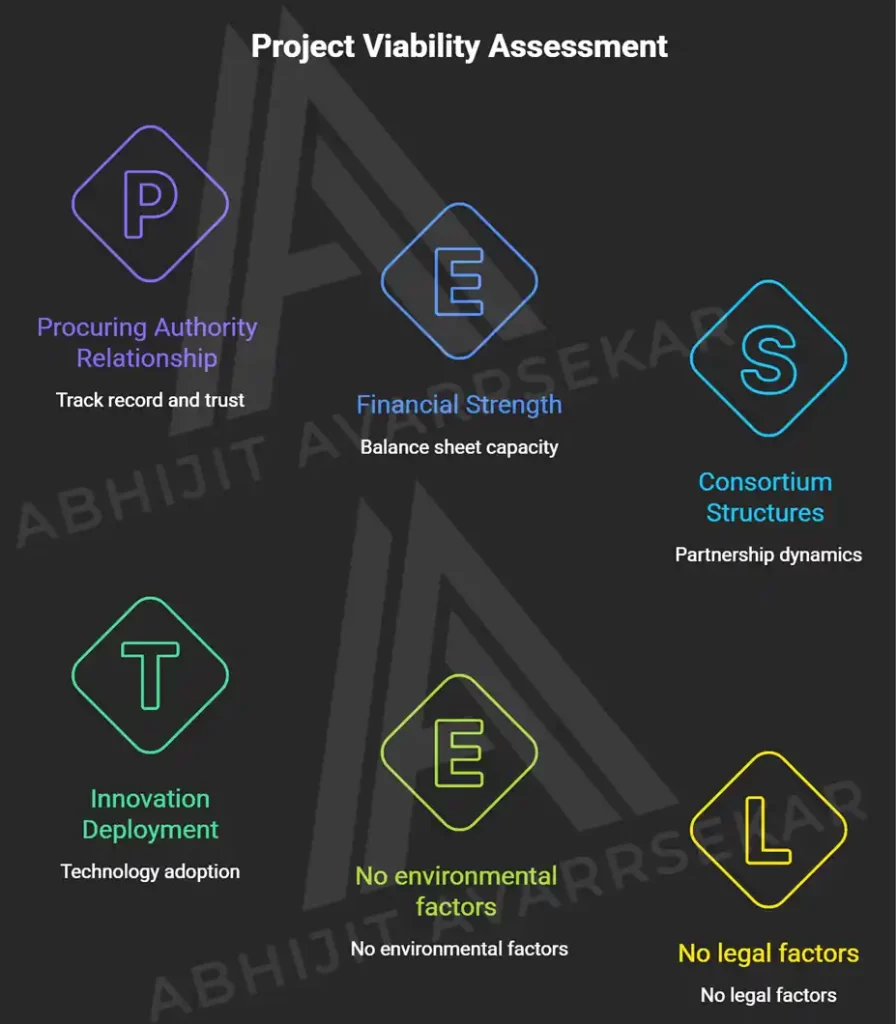
1. Past Project Portfolio.
What has each likely competitor actually delivered, and in what specific sub-sector? A company with strong national highway experience isn’t automatically strong in urban transit. Evaluators increasingly parse this distinction closely, and so should you.
2. Financial Strength and Balance Sheet Capacity.
In BOT and Annuity models particularly, evaluators assess whether bidders can absorb multi-year revenue risk. Knowing your competitors’ balance sheet positions tells you where they’re vulnerable and where you need a stronger financial narrative to compete.
3. Consortium and Partnership Structures.
Increasingly, tenders are won by consortiums that pair complementary strengths — global technology expertise with local execution credibility, as seen in Manori. Understanding how rivals are structuring their partnerships reveals what capability gaps they’re compensating for, and what gaps you may need to close in your own bid.
4. Technology and Innovation Deployment.
Evaluation matrices are increasingly weighting proven technology deployment, particularly in water, sanitation, and green infrastructure tenders. If a competitor has already demonstrated a specific technology at scale elsewhere in India, that’s a differentiator you need to either match or strategically counter.
5. Relationship and Track Record with the Specific Procuring Authority.
This is the most underestimated vector. Many companies with excellent generalist portfolios lose to bidders with a narrower but more directly relevant track record with that specific municipal body, state PWD, or central agency. Institutional familiarity is a real, if unstated, evaluation factor.
Building a Competitive Intelligence Matrix
The practical output of this analysis should be a structured matrix, not a folder of impressions. For every anticipated competitor, map their strengths and gaps across the five vectors above, then identify where your own positioning creates genuine contrast rather than incremental difference.
The goal isn’t to outspend or out-claim your rivals generically. It’s to identify the one or two dimensions where your differentiation is real, evaluator-relevant, and difficult for competitors to replicate quickly and then build your bid narrative around exactly that.
From Intelligence to Differentiation
Competitive intelligence only creates value when it changes what you actually submit. Too many companies conduct competitor research, nod at the findings, and then submit a bid that looks identical to what they would have written without the analysis.
The shift happens when intelligence directly informs bid architecture: if you know a key competitor will emphasise low-cost pricing backed by cheaper foreign capital, your bid shouldn’t try to compete on price; it should pivot decisively toward regulatory navigation, local ecosystem strength, and governance credibility, areas where price-focused bidders are typically weaker.
If you know a rival has strong technical credentials but a thin track record with the specific procuring authority, your bid should foreground institutional familiarity and delivery reliability with that exact client, not just general excellence.
This is the essence of positioning: not claiming to be the best in every dimension, but being demonstrably, specifically stronger than your most likely rivals on the dimensions the evaluators actually care about.
The Discipline Behind Winning Bids
Three decades of bagging and executing monumental infrastructure projects across urban development, transportation networks, and water and dam infrastructure have reinforced one consistent pattern: the companies that win high-value tenders aren’t always the most capable in absolute terms. They are the ones who understood the competitive field accurately enough to position their genuine strengths against it.
Competitive intelligence isn’t a compliance exercise appended to bid preparation. It’s the strategic foundation that should shape the bid before a single page is drafted.
#CompetitiveStrategy #TenderManagement #InfrastructureBidding #BusinessIntelligence #ProjectAcquisition #StrategicPositioning #InfrastructureIndia

Abhijit Avarrsekar
Strategic Growth Advisor
Synthesizing thirty years of infrastructure excellence into a future-proof Tender Winning Advisory.
Develop competitor-driven bid strategies that strengthen positioning and consistently improve infrastructure tender success rates nationwide.
Build Your Competitive Edge